Code
Body Parts Data File
The Anatomic Locations Index (ALI) is a single JSON file that validates against a schema in JSON Schema format. Release 1.0.0 has 2,899 entries.
- body_parts.json, release 1.0.0
- body_parts_schema.json
- CHANGELOG.md, which lists the changes in each release
The following figure shows every field of one entry, the uterine adnexa:
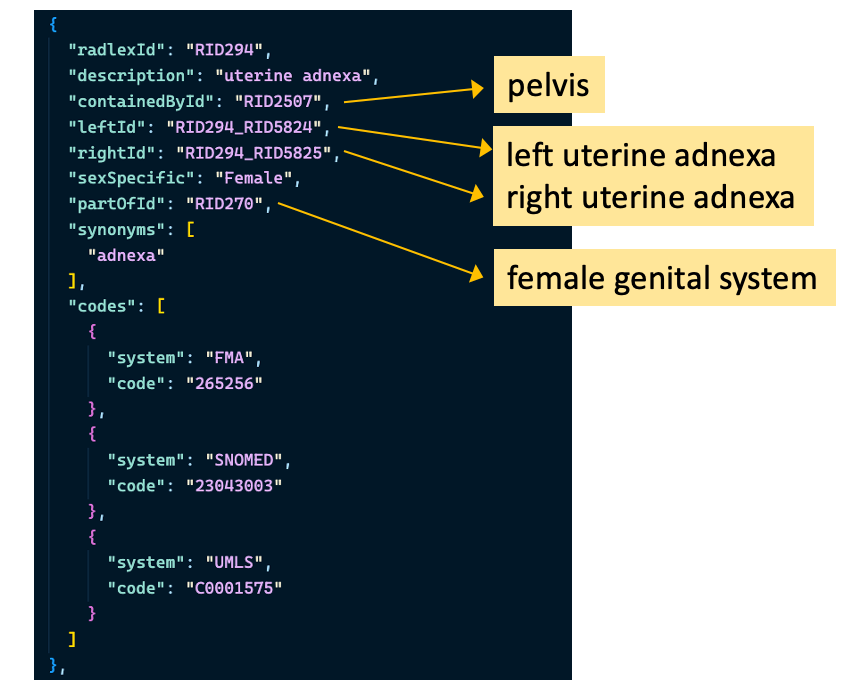
An entry can have these fields:
- RadLex ID (
radlexId): a RadLex identifier, or a post-coordinated term built from RadLex identifiers, such asRID294_RID5824for the left uterine adnexa - Description and synonyms (
description,synonyms): the preferred name and its exact English synonyms - containedBy hierarchy (
containedById): the smallest region that physically encloses the structure, such as the retroperitoneal space for the kidney - partOf hierarchy (
partOfId): the larger structure, set, or system the entry belongs to, such as the female genital system for the uterine adnexa, with at most one per entry - Laterality triads (
leftId,rightId,unsidedId): links among the unsided, left, and right entries of a paired structure, such asRID205kidney,RID29663left kidney, andRID29662right kidney - Sex phenotype (
sexSpecific):MaleorFemalefor a structure specific to one sex phenotype, such asFemalefor the uterine adnexa - Codes (
codes) in FMA, SNOMED CT, MeSH, UMLS, and TA2, with thesystemvaluesFMA,SNOMED,MESH,UMLS, andTA2
RID39569 whole body names itself as its container, so a program that follows containedById upward stops there. A left or right entry with no sided SNOMED CT concept carries a laterality expression. The right testicular artery carries 27175001:272741003=24028007, which combines the testicular artery concept 27175001, the laterality attribute 272741003, and right, 24028007.
Utility Libraries
Open-source libraries load the ALI in TypeScript and Python. Each bundles an earlier version of the data. BodyPartIndex.py loads release 1.0.0 from a downloaded file with BodyPartIndex(json_filename='body_parts.json').